Why I Am Not a Calvinist by Jerry L. Walls & Joseph R. Dongell
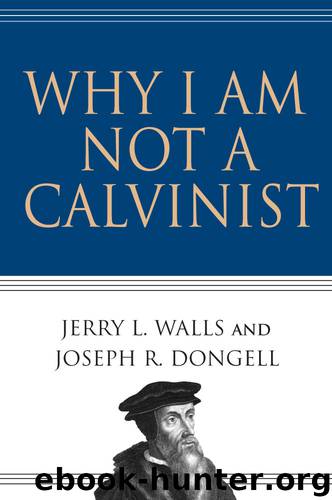
Author:Jerry L. Walls & Joseph R. Dongell [Walls, Jerry L.]
Language: eng
Format: azw3
Publisher: InterVarsity Press
Published: 2004-03-31T16:00:00+00:00
6 While the Westminster Confession can be read in a way that is broadly coherent, we believe it is still inconsistent at a deeper lever because it also has strands of libertarian freedom running through it. For argument, see Jerry L. Walls, Hell: The Logic of Damnation (Notre Dame: University of Notre Dame Press, 1992), pp. 57-70. We will take this issue up in chapter five.
Consequently, he points out, “Calvinists as determinists must either reject freedom altogether or accept compatibilism.”7 Since he believes Scripture clearly teaches that human beings are free and responsible for their actions, he believes that Calvinists must opt for compatibilism.
We appreciate Feinberg’s fairness in acknowledging that both views of freedom are at least possible. Some writers on both sides of this dispute try to avoid the debate by simply claiming that the view of freedom they reject is incoherent. We agree with Feinberg that this strategy does not further the discussion or resolve anything. While we reject compatibilism for what we believe are good biblical, theological and moral reasons, we don’t want to claim that it is a view of freedom that is not even possibly true.
Although compatibilism is a popular position among Calvinists, particularly among the philosophically informed, we want to stress that not all Calvinists embrace it. Some Reformed theologians have argued for another option. These writers do not agree with Feinberg that a Calvinist must either give up freedom altogether or accept compatibilism. To the contrary, they hold that we are required by Scripture to accept both God’s control of all things and human freedom, but they insist that it is not up to us to find a way to reconcile these truths. Popular evangelical author J. I. Packer is a proponent of this view. He endorses this position in his widely read book Evangelism and the Sovereignty of God.
As he notes, divine sovereignty and human responsibility are both clearly taught in Scripture. And he understands sovereignty in the Calvinistic sense that God unconditionally determines everything that happens. “Man is a responsible moral agent, though he is also divinely controlled; man is divinely controlled, though he is also a responsible moral agent.”8 Packer identifies this pair of claims as an “antinomy” because he believes we cannot dispense with either one of them, nor can we understand how they are compatible. From the standpoint of finite human reason, it may seem contradictory to affirm both of these claims and therefore impossible to do so. Here is Packer’s advice for dealing with such antinomies.
Download
This site does not store any files on its server. We only index and link to content provided by other sites. Please contact the content providers to delete copyright contents if any and email us, we'll remove relevant links or contents immediately.
The Secret Power of Speaking God's Word by Joyce Meyer(3159)
Signature in the Cell: DNA and the Evidence for Intelligent Design by Stephen C. Meyer(3123)
Real Sex by Lauren F. Winner(3005)
The Holy Spirit by Billy Graham(2938)
The Gnostic Gospels by Pagels Elaine(2517)
Jesus by Paul Johnson(2349)
Devil, The by Almond Philip C(2323)
23:27 by H. L. Roberts(2245)
The Nativity by Geza Vermes(2222)
Chosen by God by R. C. Sproul(2158)
All Things New by John Eldredge(2151)
Angels of God: The Bible, the Church and the Heavenly Hosts by Mike Aquilina(1951)
The Return of the Gods by Erich von Daniken(1925)
Angels by Billy Graham(1917)
Knowing God by J.I. Packer(1848)
Jesus of Nazareth by Joseph Ratzinger(1802)
The Gnostic Gospel of St. Thomas by Tau Malachi(1781)
How To Be Born Again by Billy Graham(1775)
Evidence of the Afterlife by Jeffrey Long(1773)
